Behavioral Analysis
Detecting impairment patterns through cognitive and motor behavior signals using non-invasive methods.
ClarScan
ClarScan uses patented multimodal technology and AI-driven analysis to detect impairment through behavioral and biosignal screening, enabling smarter safety decisions across mobility, workplaces, and everyday life.
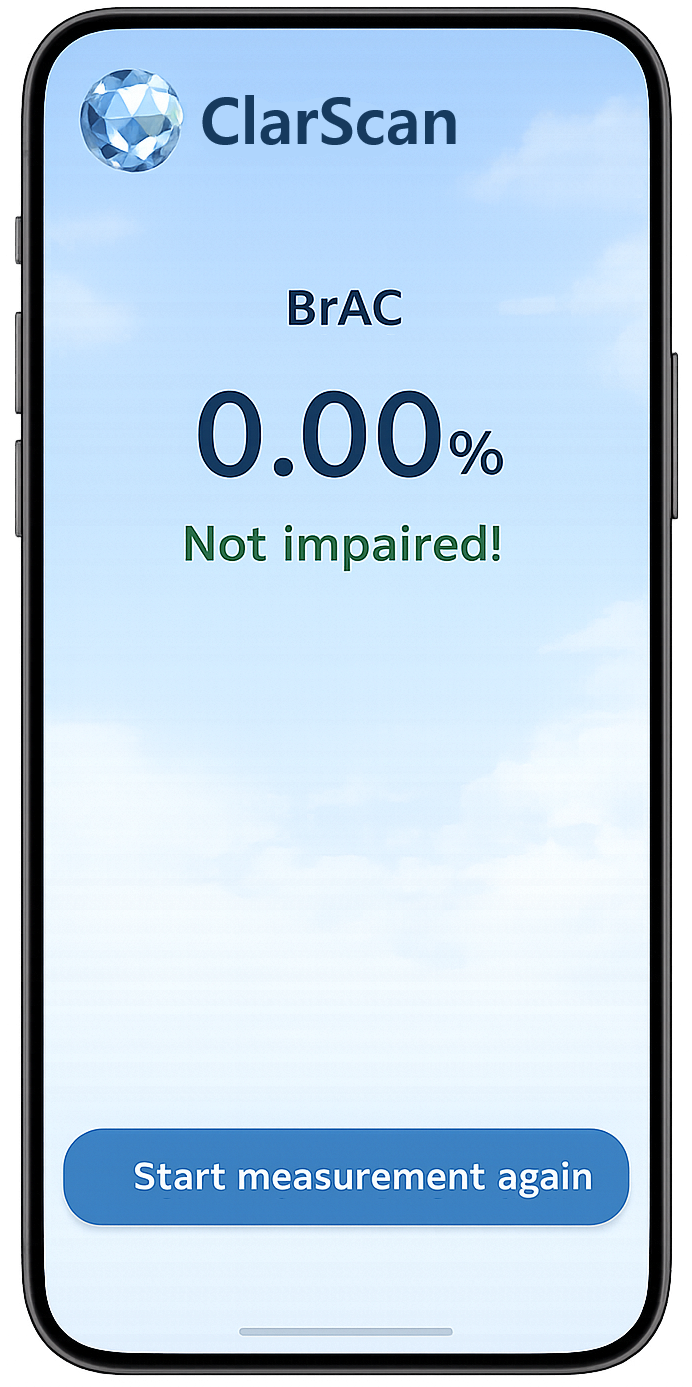
ClarScan is a multimodal impairment-intelligence platform that combines behavioral and biosignal analysis with AI to enable faster, smarter, and more privacy-conscious safety decisions.
Detecting impairment patterns through cognitive and motor behavior signals using non-invasive methods.
Leveraging physiological indicators to assess readiness and impairment risk in real time.
Turning multimodal data into actionable safety decisions — for individuals, workplaces, and mobility systems.
From personal readiness checks to enterprise-grade mobility APIs. ClarScan adapts to the safety needs of individuals, businesses, and governments.
An app for personal readiness check powered by multimodal signals. Know your state and block chosen actions before critical activities privately and instantly.
Screen workforce readiness and impairment risk with privacy-aware behavioral and biosignal analysis integrated into your safety protocols.
Road safety intelligence for transport, fleet, rental, and mobility operators. Detect risk before it becomes an incident.
Continuous monitoring and compliance verification for regulated environments — built on the same modular core.
ClarScan SelfGuard app gives individuals the ability to check their readiness and safety before critical activities using multimodal signals and privacy-aware analysis. No diagnosis. No data sharing. Just clarity.
Learn More About SelfGuardAssess your readiness in moments before driving, working, or any critical activity.
Optional safeguards that actively block selected phone actions.
Users define what to restrict: calls or messages to specific contacts (e.g. boss, ex), selected apps, and chosen websites (e.g. web casinos).
Built on an evolving core model that improves over time with better training data, delivering more accurate and reliable safety insights.
A streamlined pipeline that transforms multimodal inputs into actionable safety intelligence — reliably and privately.
Non-invasive behavioral and biosignal data is collected through sensors or device interactions.
Raw inputs are filtered and normalized on-device before transmission, minimizing data exposure.
Multimodal signals are processed through proprietary models for impairment pattern detection.
A structured risk assessment is generated, calibrated for the specific use case and context.
Results trigger configurable actions — alerts, access control, reports, or downstream API calls.
Impairment detection demands trust. Our platform is built on privacy-first principles that protect individuals while enabling smarter safety decisions.
Privacy is not an afterthought. Our architecture minimizes data collection and only processes what is strictly necessary for safety assessment.
Built for European data protection standards. Consent-driven, transparent, and fully aligned with GDPR requirements.
End-to-end encryption, secure transmission, and strict access controls protect every data point in the pipeline.
We never track, profile, or monitor individuals beyond the assessment moment. We provide a simple impaired/not impaired assessment. What customers do with that information is entirely up to them.
ClarScan's technology is designed to push the boundaries of impairment detection. Our proprietary signal-processing pipeline and modular product architecture enable rapid expansion into new safety domains while maintaining the highest standards of privacy, accuracy, and performance.
We believe the next generation of safety systems will be multimodal, privacy-first, and intelligent by default. ClarScan is building that future.
Combining behavioral, physiological, and contextual signals into a unified assessment framework for higher accuracy and reliability.
A modular platform built from reusable components, enabling new products to be assembled and deployed quickly for different user groups and integration needs — from personal apps to enterprise API integrations.
Cloud-native, event-driven architecture built to handle millions of assessments while maintaining latency and compliance requirements.
An evolving signal library and model pipeline that improves with new research, data patterns, and deployment feedback.
Quick answers about CLARSCAN, product direction, and how to collaborate with us.
CLARSCAN is a solution integrated into smart devices that helps assess a person's sobriety and reduce alcohol-related risks. The focus is on privacy-conscious processing and practical usability in everyday situations.
Alcohol-influenced decisions and actions create risks for both individuals and others, from personal mistakes to traffic and workplace safety issues. CLARSCAN aims to provide a convenient, non-intrusive, and scalable way to detect risks early.
CLARSCAN is designed for multiple use cases: first CLARSCAN SelfGuard (personal self-check), then CLARSCAN Mobility (mobility and driving context), and later Workplace (workplace safety and process support).
SelfGuard focuses on personal self-assessment and prevention. Mobility links assessment to situations where movement and driving are critical. Workplace applies the solution within safety frameworks and company processes.
CLARSCAN combines behavioral and physiological signals (e.g., speech, facial, and reaction patterns), and in the future may include miniature chemical sensors. The exact signal set may vary across versions.
CLARSCAN is not primarily a traditional breathalyzer. Its goal is to assess the likelihood of impairment and risk level in context, rather than provide a legally binding BAC value.
Accuracy depends on the signal set used, device, usage context, and validation data. Development is iterative: prototypes, pilots, validation studies, and model improvements.
Yes, like any risk assessment system, CLARSCAN may produce false positives or false negatives. Therefore, it emphasizes risk awareness, context, and recommendations (e.g., "do not drive") rather than binary decisions.
CLARSCAN is designed to prioritize privacy-conscious processing and minimal data flow. When data sharing is required for integrations, it is done with clear consent, minimal data use, and security measures.
The goal is to avoid unnecessary storage. Results may be aggregated or score-based. Where storage is necessary (e.g., scientific validation), it is explicitly agreed upon, transparent, and limited.
The target is for core functionality to operate online, as the risk assessment algorithm runs on servers rather than the device. Internet may also be needed for updates, pilot reporting, or integrations. Offline mode may be possible in the future.
CLARSCAN focuses on smart device integration, multimodality, usability, and privacy. It also supports progression from SelfGuard to Mobility and Workplace to cover different risk contexts. The platform does not require additional hardware, unlike most competitors.
Its primary positioning is as a safety and risk reduction tool, not a medical diagnostic or legal evidence instrument. The regulatory framework depends on the final use case and claims, and is evaluated during development.
Primarily, we are seeking pilot partners, team members, and strategic collaborators to validate CLARSCAN SelfGuard and accelerate Mobility development. We are also open to both equity and non-equity funding, as well as R&D partnerships in sensors and validation.
If you are interested in collaboration, integration, or investor/partner introductions, get in touch and we will outline the next steps (demo, workshops, pilot plan, timeline).
ClarScan builds on peer-reviewed work showing that alcohol-related impairment can be assessed through smartphone sensors, speech, movement, eye-related signals, and multimodal machine learning — not only chemical breath or blood tests. See our curated list of articles and DOIs on the Articles & DOIs page, including a summary of how this research informs our approach.
Whether you're exploring a pilot, evaluating partnership opportunities, or looking to integrate impairment intelligence into your platform — we'd like to hear from you.
We're currently open to pilot programs, strategic partnerships, and early-stage collaborations.